What is one of the hardest things for a leader to say? Perhaps it is simply this: “I was wrong. I take responsibility.” In politics, business, ministry and public leadership, admitting failure can feel costly. There is often pressure to explain, defend, shift the blame or protect the image of the institution. But leadership is not proven by never making mistakes. It is revealed by what happens when the mistake becomes impossible to ignore.
The Bible gives us two very different pictures of leadership through King Saul and King David. Saul was confronted by the prophet Samuel after disobeying God’s instruction concerning the Amalekites. His first instinct was to explain himself. He blamed the people and presented the disobedience as something that had been done for a religious purpose. Later, even after admitting that he had sinned, Saul was still deeply concerned about how he appeared before the people. His reputation remained part of the conversation. His confession sounded right, but his heart was still concerned with preserving his position.
David’s response was different. His failure was serious. He committed adultery with Bathsheba and arranged circumstances that led to the death of her husband, Uriah. When Nathan confronted him, David did not hide behind his position as king. He simply said, “I have sinned against the Lord.” He eventually expressed the depth of his repentance in Psalm 51, asking God for a clean heart and a renewed spirit. David did not escape the consequences of what he had done, but he stopped defending himself and allowed the truth to confront him.
There is a difference between admitting something because you have been caught and genuinely allowing the truth to change you. One protects the image. The other deals with the person behind the image. That difference matters enormously in leadership.
We see the same struggle today. When a policy fails, when an organization makes a serious mistake, when corruption is uncovered or when a decision causes harm, the temptation can be to manage the story rather than address the problem. But no amount of communication can permanently replace accountability. A polished explanation may protect an image for a moment, but real leadership requires the courage to ask what went wrong, accept responsibility and make the necessary changes.
Repentance, then, is not weakness. It is not the end of leadership. In the biblical sense, genuine repentance is a turning. It means recognizing that something is wrong, taking responsibility and changing direction. That kind of humility can be difficult, particularly for people who have spent years being expected to appear strong and certain. Yet it may be one of the most important qualities a leader can develop.
This also challenges those of us who follow leaders. Accountability matters, but so does the way we respond when someone genuinely acknowledges failure and begins to make things right. Holding people responsible does not have to mean wishing for their destruction. Justice and mercy do not have to be enemies.
The deeper question is one every leader eventually has to face: When the truth exposes my failure, will I protect my image or allow myself to be changed?
A leader does not become smaller by admitting a mistake. Sometimes, that is the moment real leadership begins.
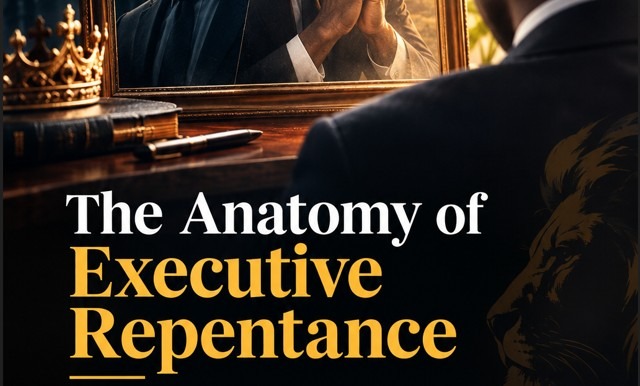
That is the heart of Episode 5 of Kings & Presidents, “The Anatomy of Executive Repentance.” Through the stories of Saul and David, the episode explores the difference between cosmetic repentance and genuine transformation, and what that difference means for leaders, institutions and nations.
For more conversations on biblical leadership, Kingdom leadership, governance, purpose and transformational leadership, visit Njeri Muchunu Global.
You can also continue listening to the Kingdom Blueprint Show on Spotify, and watch the latest teachings and conversations on Kingdom Blueprint Show YouTube content.
The question is not whether leaders will make mistakes. The question is what they will do when the truth catches up with them.